Customs clearance is where Vietnam import-export timelines are won or lost. The paperwork is digital, the rules are knowable, and yet shipments still sit at Cat Lai and Hai Phong for days over preventable errors. This guide walks through the full customs clearance procedure in Vietnam — step by step, with the traps marked.
Everything below reflects how clearance actually runs through Vietnam’s e-customs system today. It applies to commercial sea and air freight imports (the export flow mirrors it with fewer steps). For hands-on help, this is exactly what our customs clearance services in Vietnam team does daily.
How Customs Clearance Works in Vietnam: The System
Vietnam runs customs declarations through VNACCS/VCIS (Vietnam Automated Cargo Clearance System / Vietnam Customs Intelligence Information System), the national e-customs platform operated by the General Department of Vietnam Customs, in operation since 2014. Declarations are filed electronically; the system applies risk-based channeling to decide how much scrutiny each shipment gets. The legal backbone is the Law on Customs 2014 and its implementing decrees and circulars.
Two facts shape everything else:
- Your risk profile is scored per declaration. The declarant’s compliance history, the goods, the HS codes, and the declared values feed the channel decision.
- Import duty and taxes are generally payable before goods are released, unless covered by a bank guarantee. Slow tax payment = slow release, even with a green channel.
The 6 Steps of Customs Clearance in Vietnam
Prepare the dossier & classify HS codes
Assemble invoice, packing list, B/L, C/O. Classify each item to Vietnam’s 8-digit HS code (AHTN-based). This step decides your duty rate and specialized-inspection obligations.
File the declaration on VNACCS
Submit the electronic declaration — before arrival or within 30 days of goods arriving at the checkpoint. Pre-arrival filing is the single easiest way to save days.
Channel assignment
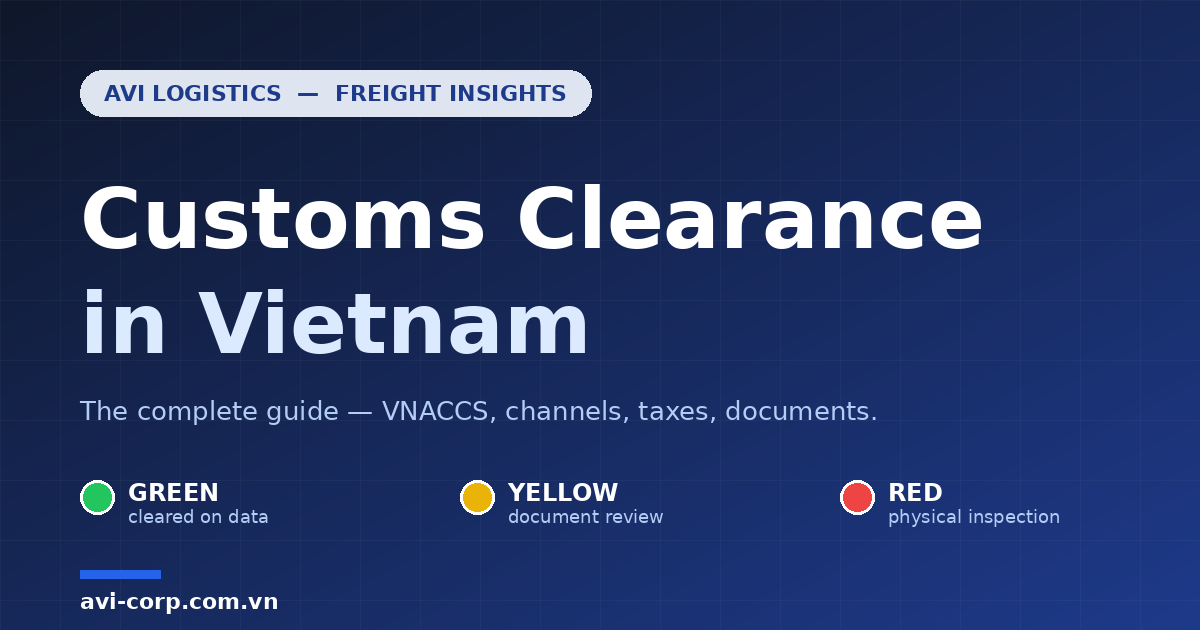
VNACCS returns green, yellow, or red. Green clears on data; yellow means document review; red adds physical inspection of the goods.
Pay duties & taxes
Import duty, VAT, and any excise or environmental tax are paid electronically via banks linked to customs. Release follows payment (or a valid guarantee).
Specialized inspection (if applicable)
Food, plants, animals, cosmetics, machinery with efficiency standards, and many other categories need quality, quarantine, or safety checks by line ministries — this often takes longer than customs itself.
Release & post-clearance
Goods are released; records must be kept — customs can conduct post-clearance audits for years after release, so the file has to stand on its own later.
The Three Channels — and How to Stay Green
Green (Luồng xanh)
Cleared on the declaration data alone. Typical release the same day once taxes are paid. This is where compliant, well-documented shippers live.
Yellow (Luồng vàng)
Customs reviews the paper dossier against the declaration. Adds hours to a day or more, depending on queue and question rounds.
Red (Luồng đỏ)
Document review plus physical inspection of the goods. Expect one to several extra days, plus handling costs — and knock-on storage charges.
Channeling is risk-based, so it responds to behavior over time: consistent HS classification, realistic declared values, clean compliance history, and complete dossiers all push you toward green. Repeated amendments, valuation disputes, and misclassification push you toward red — for future shipments too.
Documents Checklist
| Document | Notes |
|---|---|
| Customs declaration | Filed electronically via VNACCS |
| Commercial invoice | Values must be defensible under transaction-value rules |
| Bill of lading / Air waybill | Sea or air transport document |
| Packing list | Must reconcile with invoice and physical cargo |
| Certificate of Origin (C/O) | Only if claiming preferential FTA duty — e.g., Form D (ATIGA), Form E (ASEAN–China), EVFTA, CPTPP, RCEP documentation |
| Licenses / specialized-inspection registration | For regulated goods: food safety, quarantine, quality standards, energy efficiency, etc. |
Exact requirements vary by commodity — the HS code drives the list. When in doubt, resolve the HS code first; everything else follows from it.
Import Taxes at Clearance
| Tax | Basis | Notes |
|---|---|---|
| Import duty | HS code × origin | MFN rate by default; preferential FTA rate with a valid C/O — often 0% under ATIGA, ACFTA, EVFTA, CPTPP, RCEP depending on the goods |
| VAT | (CIF value + import duty) | Standard rate 10%; certain goods 5% or exempt; temporary economy-wide reductions have applied in recent years — check the current rate for your goods |
| Special consumption tax | Selected goods | Cars, alcohol, tobacco, and other excisable categories |
| Environmental protection tax | Selected goods | Fuels, certain chemicals and materials |
Customs value follows the WTO valuation rules — transaction value first, alternative methods only in sequence if it can’t be used. Undervaluation is the fastest route to a valuation dispute, a red channel history, and post-clearance audit exposure.
Where Shipments Actually Get Stuck
- HS misclassification — wrong code means wrong duty, wrong licenses, possible penalties, and re-filing. The single biggest source of disputes.
- C/O errors — a preferential claim with a defective C/O (wrong form, tolerance breaches, formality errors) gets rejected, and the duty difference lands on you.
- Specialized inspection not registered in advance — customs may be done in hours while a quality or quarantine check holds the container for days.
- Invoice–packing list–declaration mismatches — quantity or description inconsistencies trigger yellow/red treatment.
- Late tax payment — a green channel means nothing if the duty transfer hits the bank after cut-off.
Almost every one of these failure modes is a data problem before it is a customs problem — wrong code, mismatched line items, missing registration. That is why checking the file before it reaches VNACCS beats fixing it after the channel comes back yellow.
How AVI Clears Faster: AI Before the Declaration
A traditional customs broker types your documents into VNACCS and reacts to whatever channel comes back. AVI puts an AI layer in front of the filing:
Traditional Broker
- Manual HS lookup from experience and paper tariff books
- Documents checked by eye, under deadline pressure
- Channel result discovered after filing
- Specialized inspection handled when it surfaces
AVI — AI-Assisted Clearance
- AI HS classification support — candidate codes with duty and license implications, validated by licensed staff
- Automated document pre-check — invoice, packing list, and declaration reconciled line by line before filing
- Channel-risk awareness — declarations structured for consistency, protecting your green-channel history
- Specialized-inspection flags up front — registration started before the vessel arrives, not after
The result is fewer yellow and red channels, and clearance that starts before the ship docks. It’s the same philosophy behind our AI logistics platform — and it pairs with mode decisions too: on consolidated cargo, one co-loaded shipment’s red channel can hold your goods, which is one more input in the FCL vs LCL decision. If one team handles both your freight forwarding in Vietnam and the customs declaration, booking data flows straight into the customs file — no re-keying, fewer mismatches.
The Bottom Line
- File early — pre-arrival declaration is free time savings
- Get the HS code right first — it drives duty, licenses, and inspection obligations
- Protect your channel history — consistency today is green channels tomorrow
- Start specialized inspection before arrival — it’s the hidden critical path
- Keep the file audit-proof — post-clearance audit can revisit shipments years later
Clear Customs Without the Drama
Send us your commodity list and we’ll flag HS codes, licenses, and inspection requirements before your cargo moves — so the channel that comes back is green.
Frequently Asked Questions
How long does customs clearance take in Vietnam?
With a green channel and taxes paid, release is typically same-day. Yellow channel adds hours to a day or more for document review; red channel adds one to several days for physical inspection. Specialized inspections for regulated goods can extend timelines beyond customs itself.
What documents are required for customs clearance in Vietnam?
The core set is the electronic customs declaration (via VNACCS), commercial invoice, bill of lading or air waybill, and packing list. A Certificate of Origin is added when claiming preferential FTA duty, and licenses or specialized-inspection registrations apply to regulated goods depending on the HS code.
What do the green, yellow, and red customs channels mean in Vietnam?
They are risk-based processing levels assigned per declaration: green clears on the declared data, yellow requires a document review, and red requires both document review and physical inspection of the goods. Compliance history and declaration quality influence which channel you receive.
What taxes are paid at import into Vietnam?
Import duty (MFN or preferential FTA rate with a valid C/O), VAT calculated on the duty-inclusive value (standard rate 10%, with reduced rates or exemptions for certain goods), plus special consumption tax and environmental protection tax on specific categories.
Do I need a Certificate of Origin to import into Vietnam?
Only if you want preferential duty rates under a free trade agreement such as ATIGA, ACFTA, EVFTA, CPTPP, or RCEP. Without a valid C/O (or applicable origin documentation), the shipment clears at the standard MFN duty rate.
How does AVI Logistics speed up customs clearance?
AVI applies AI before the declaration is filed: HS classification support validated by licensed customs staff, automated line-by-line document reconciliation, declarations structured to protect green-channel history, and early flagging of specialized-inspection requirements so registration starts before cargo arrives.